We see that technology should be purpose-built to support production performance rather than technology-driven complexity.

We develop technology that expands what is possible in aquaculture.
Designed for both economic and environmental sustainability, the The Paras Precision Hybrid Flow-through System offers practical, scalable solutions that enhance fish welfare while improving farm productivity — making it a profitable and viable choice for both large-scale operations and smaller producers alike.
We see that technology should be purpose-built to support production performance rather than technology-driven complexity.
We believe that production systems can be designed more efficiently and with greater simplicity than current approaches.
To meet the growing global demand for farmed fish, land-based aquaculture must scale significantly — requiring solutions that ensure profitability while meeting increasingly strict environmental standards.
A simplified system architecture enables a high level of automation, improves operational reliability, and significantly reduces technical and operational risk.
The Paras Precision Hybrid Flow-through System is an innovative solution that combines cost-efficiency with environmental sustainability. Its factory-built, modular design enables rapid deployment and high operational efficiency.
By optimizing the use of production resources, our technology significantly reduces CAPEX and OPEX, making land-based aquaculture both viable and competitive.
Paras technology is defined by its modular design, enabling fast deployment, flexible scaling, and efficient use of space and capital. Production can be easily expanded by adding modules.
Unlike conventional RAS systems, it operates without a costly biofilter and reaches full capacity immediately after installation, with no need for separate depuration tanks.
Cost-efficiency is achieved through fewer, high-quality components, maximizing space utilization while reducing the risk of failures.
Paras technology boosts production by simplifying processes and reducing operating costs. It uses less water and energy, with demand-driven and automated functions improving efficiency.
Without a biofilter, fish reach the market faster without depuration losses, while allowing flexible disinfection and improved biosecurity.
Advanced automation, optimized water and temperature control, and high-quality components ensure reliable, efficient, and cost-effective production.
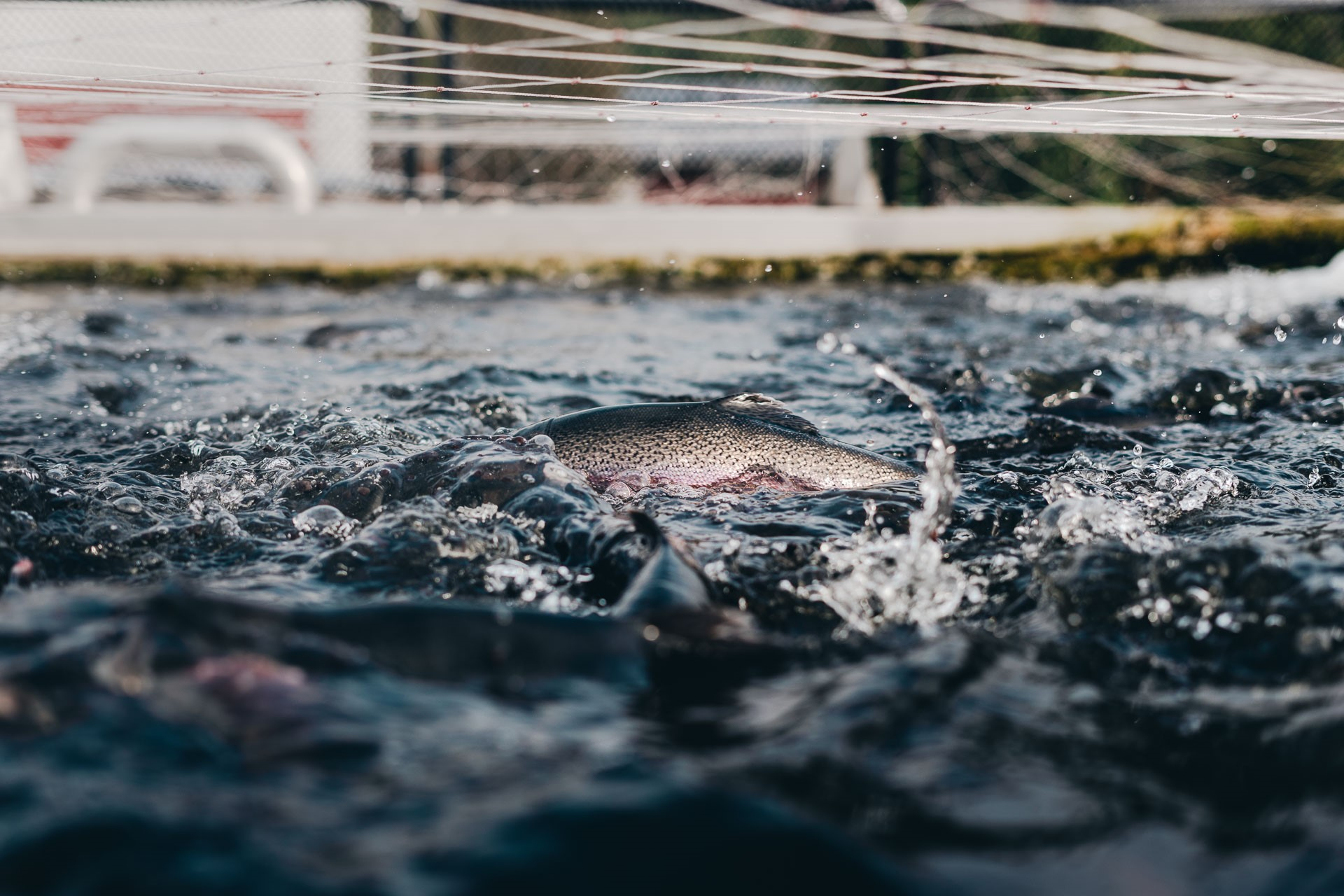
The Paras Precision Hybrid Flow-through System is built on technology where fish welfare is at the core—the foundation of long-term economic success in aquaculture. The Paras facility concept is designed to enhance disease prevention while providing fish with a more enriched environment, including more natural variation in swimming patterns.
Our method promotes fish health and consistent production performance, resulting in strong growth, low mortality, excellent feed conversion ratios, and premium product quality. By operating with fewer resources, the system significantly enhances overall farm efficiency.

Our system is designed to minimize environmental impact, enabling safe facility development and ensuring truly sustainable production. It operates with low water consumption and reduced energy use, resulting in a smaller carbon footprint.
The Paras Precision HFS further enhances environmental performance through chemical-free treatment that simultaneously reduces nutrient emissions and increases the efficiency of nutrient utilization. In addition, the system supports biosafe production, strengthening both environmental responsibility and operational reliability.
Together, these features redefine what sustainable aquaculture can achieve.
Our facility concept is fully scalable to facilities of different sizes. Regardless of the number of tanks, the system is designed as a carefully optimized and finely tuned whole—down to the smallest detail.
Explore the different components and solutions of the facility in more detail by clicking on different areas of the image.
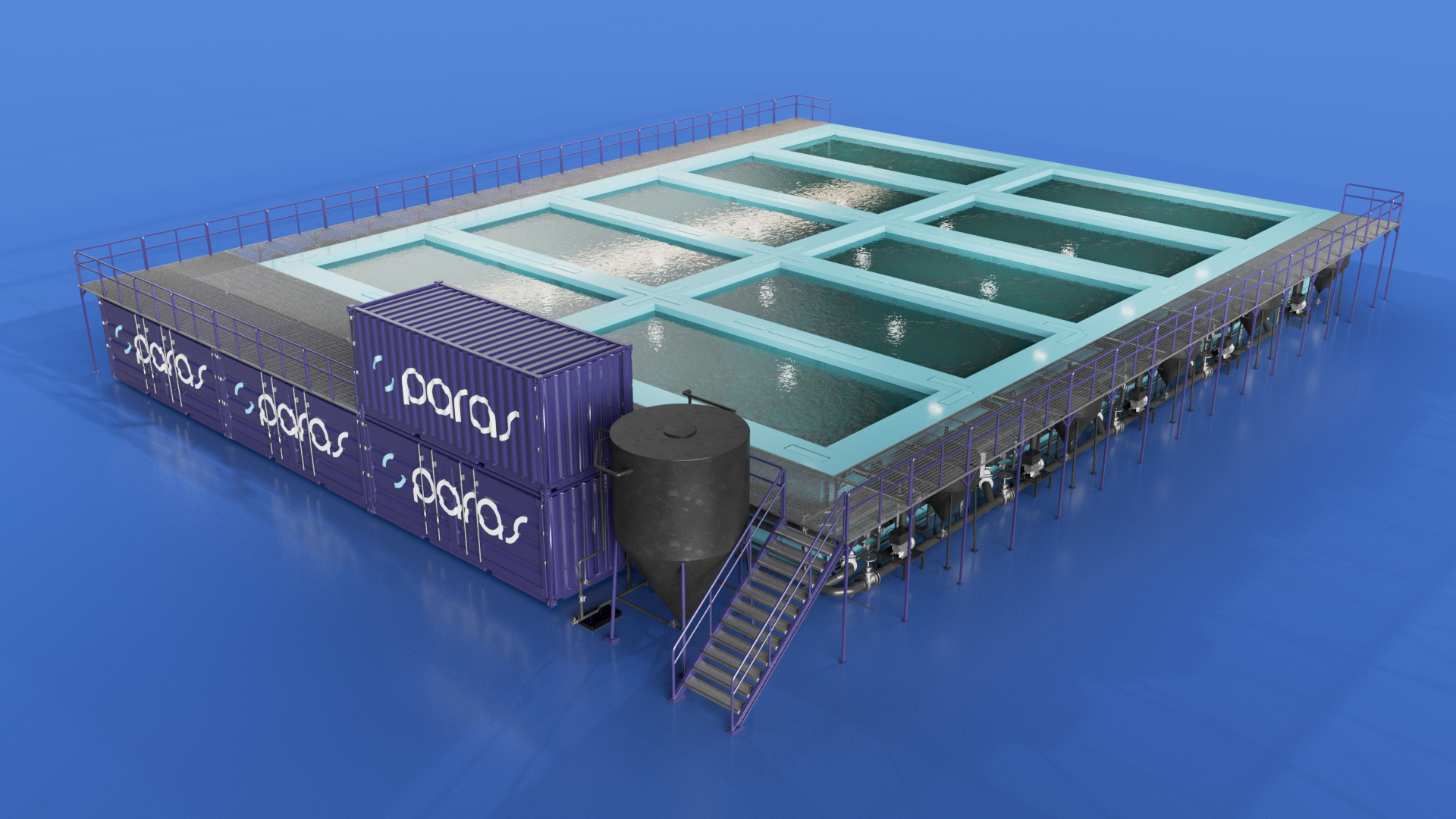
PreciseFlow tank units, enabling adjustable flow patterns and stable oxygen, carbon dioxide, and ammonia levels through tank-specific automation, supported by excellent hydraulics and self-cleaning properties. Fish welfare is enriched by varying flow direction and speed, and the conditions in each tank can be adjusted according to the needs of the fish.
Water is kept separate between tanks to prevent cross-contamination. While certain utilities, such as temperature control, are managed centrally at the farm level, the key components related to production performance and biosafety operate at the individual tank level. This decentralised structure enables optimization of conditions at the tank level and significantly reduces both biological and technical risks.
A modular architecture with prefabricated elements enables fast installation and rapid commissioning. The efficient use of space supports scalability and cost efficiency, while full production capacity is available immediately after installation. Expansion is straightforward through the addition of new modules or extended tank lines.
No biological filtration needed. The system relies on mechanical water treatment combined with continuous low-rate renewal.
Fully visible structures are easy to disinfect and access, simplifying maintenance.
The dual-piping system allows tank-specific temperature control.
Efficient, chemical-free nutrient recovery takes place directly beside each tank. By capturing solids in radial-flow settlers and removing them automatically before nutrient dissolution occurs. The fertilizer value of the sludge is preserved, as nutrients are not bound by chemicals.
Advanced automation ensures reliable operation through smart water quality and temperature control, automatic feeding and solids removal, and a secured, decentralized electrical system. Fully adjustable lightning and feeding rhythms.
High-quality components are at the core of the simplified system design, enabling high performance with fewer overall components.
Precise temperature control. Temperature regulation provides additional operational flexibility, as tank temperatures can be adjusted according to different production stages and specific farming requirements. Also “temperature as medicine” approach can be used to prevent and control temperature related diseases.
Continuous water quality monitoring combined with an efficient water reuse system ensures consistent performance. Effective intake and discharge water treatment support stable operation and optimal production conditions — maintaining continuously fresh and clean water throughout the process.
Water quality management system and SCADA developed for HFS.
Beyond delivering the facility itself, we provide comprehensive support across the entire project lifecycle, from planning and implementation to operational optimization.